
Oracle resume format — what actually gets shortlisted
Oracle India hires fresher engineers across its applications businesses, database and server technology groups, and the fast-growing Oracle Cloud Infrastructure (OCI) organisation — and the screens differ enough that your resume should pick a target. OCI screens like a cloud-native product company (distributed systems, DSA, operational thinking); the applications and database sides reward strong CS fundamentals with SQL depth that most freshers underestimate.
Pay once — no subscription · Your resume is never sold · No credit card
- Oracle campus hiring (Applications/Server Technology/OCI teams)
- Off-campus engineer hiring
- Internship-to-FTE conversions
Across all of them, Oracle's screen has a fundamentals bias befitting the company that owns the database: SQL fluency beyond SELECT, memory-and-complexity awareness, and evidence you understand what happens under your code. A fresher who can talk indexing and query plans, or who has built something with real concurrency, stands out in an Oracle pipeline more than a framework-collector does.
What Oracle's screening actually checks
- CS fundamentals depth: DSA, operating systems, DBMS — interviews probe them hard
- SQL beyond basics: joins, indexing awareness, query optimisation evidence
- OCI lane: distributed-systems vocabulary, Linux, networking, operational thinking
- Project rigour: concurrency, performance measurements, design decisions
- Academic solidity — Oracle campus screens weigh CGPA more than services firms do
The Oracle resume format rules
- 1.One page; header carries coding profiles and GitHub — product-company norms
- 2.Show SQL depth explicitly: 'optimised a query from 4s to 200ms by adding a composite index' is an Oracle-native bullet
- 3.Target a lane: OCI (cloud/distributed) vs applications (Java/SQL enterprise) — write the headline for it
- 4.One bullet with performance numbers per project: latency, throughput, memory
- 5.Fundamentals coursework strength (OS, DBMS, networks) is worth a line here, unlike at services majors
- 6.Avoid framework soup; depth in Java/C++ plus real SQL beats six half-known libraries
Sample: a Oracle-ready resume core
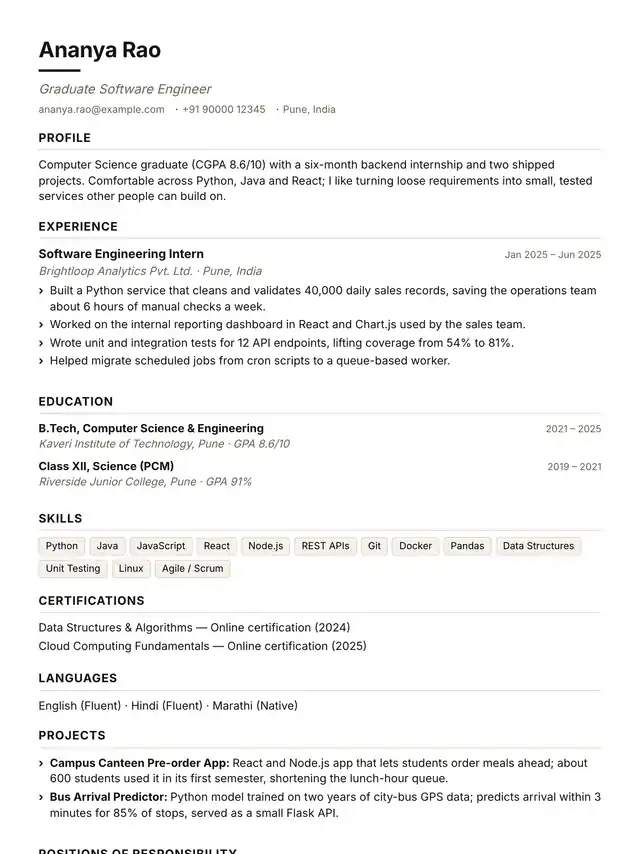
The headline, summary, skills and proof bullets — the parts Oracle's screen reads first.
CS graduate (9.1 CGPA, Hyderabad) with a fundamentals-first profile: 500+ DSA problems, advanced SQL including indexing and query-plan work, and a multithreaded systems project with measured performance. Targeting Oracle OCI/server-technology fresher roles.
Java (multithreading) · SQL (indexing, query tuning) · C++ · DSA (LeetCode 1720) · Linux · Operating Systems · Git · REST APIs
- Optimised the slowest query in a college ERP module from 4.2s to 180ms via composite indexing and query restructuring (MySQL, 300k rows)
- Built a multithreaded log-ingestion service in Java (producer-consumer, 40k lines/sec sustained on a laptop benchmark)
- LeetCode 1720; 500+ problems; ranked 2nd of 240 in the department's DBMS course
Want this shape with your details? The AI builds it from your existing resume — then download PDF + DOCX from $9, one-time.
ATS keywords that matter for Oracle
Weave these into your skills and bullets where they're true — exactly as spelled.
- Java
- C++
- SQL (advanced)
- Data Structures & Algorithms
- DBMS
- Operating Systems
- Distributed Systems
- Linux
- REST APIs
- Multithreading
- Cloud (OCI/AWS basics)
- Git
Oracle resume — common questions
Make your resume Oracle-ready in one sitting.
Scan free, see exactly what Oracle's screening would flag, let the AI fix it, and download a recruiter-grade PDF + DOCX from $9 — one-time, no subscription.
No credit card · no signup to scan · 30 seconds